Friday, 15 July 2011

Day 4: Thursday = Saturday

The day started on a sad note – a member of staff here was a close friend of a local man whose brother’s family have all just been murdered. Everybody around them feels very traumatised and upset. A few of us talked about it first thing this morning, and we were all affected by the horror of it – especially for those who are closest to the family.

Today is weekend – although it is a Thursday, today and tomorrow are on all the calendars and computers as the two days of rest.  Thursday is traditionally just a half day and Friday is the day for prayers – as in all Islamic countries, of course. Modernisers recently are trying to pass a parliamentary bill to change the weekend to Friday and Saturday, so it would be at least aligned with the western world of commerce and business for four and not three days of the week. The government is trying to support it - but it is a very sensitive and complex matter, and will need a great more discussion before it is agreed. So Saturday remains the first day of the week and Sunday the second: while we are feeling Monday Morning Blues, people here are already nearly half way through their working week. However, like home, many shops and businesses are open at weekends (including the psychiatrists seeing their private patients – see day 2). I wonder if there has ever been a Friday equivalent of the British ‘Keep Sunday Special’ campaign here – I suppose it is an inevitable consequence of global commercialisation that such sentiments do not have the same priority as economic ones.

But in a quirky way, the shifted weekend is an extra ‘disorientator’ that keep humans aware that different places in the world are actually different – however hard we try to homogenise our lifestyles in the name of progress. So alongside the daily and annual astronomical ones (time zones and seasons), we have the cultural one of religious beliefs: the weekly one of weekends, and the annual one of festivals and holidays. So – and perhaps this is getting a little far-fetched – we have the astronomical or cosmic anchors to the land (day and night, winter and summer) and the cultural or spiritual anchors to our fellow humans (weekends and festivals). And anchors like these, I would propose, provide an internal experience of containment through ‘knowing what’s when’ – and keeping the terrors of uncertainty safely at bay. Which is, of course, just what we do with our time boundaries in psychotherapy and therapeutic communities…

But for me, the experience here is definitely of a Saturday – ignoring the alarm clock, getting up for a leisurely breakfast, and not worrying exactly what needed doing today. And the extra bonus of having interesting conversations with my housemates about many things as we just chill out and hang loose, as they say.
And indeed, on that theme, one was language and idioms.  Yousuf’s first language is Persian (also known as, or nearly the same as, Farsi or Dari), and Raymond’s is Swahili. But like most under-educated Brits, my only language is English, so our chewing of the fat had to be in English. Though I did notice that we used quite a lot of hand-gestures to describe nuances and subtle grades of meaning, especially when the English wasn’t quite good enough to express something.

Another aspect of language which is more directly relevant to our mental health work is analysis of the qualitative data on our teaching evaluation forms. The numerical data is simpler – one can either cheat with the analysis, or do it correctly; and we all trust our staff to not cheat when entering the quantitative data into spreadsheets. However, in mental health, it is often the qualitative data that gives more information about meanings and relationships: and here, even the process of translation may introduce bias. For example, the evaluation forms have comments on them which are written in Persian, but need analysing in English. Our interpreter is a member of the team, but also a local young woman, and both English and Persian are second languages to her. To help with some of the trickier written responses, she discusses them with one of the psychiatrists who has good English. At least three sources of bias come in here: (i) she goes to ask different people, who all tell her slightly different things; (ii) the psychiatrist is senior to her, so she is culturally unable to disagree with any of his or her opinions; (iii) both of them may, probably unconsciously, choose wording which does not offend local or national sensitivities. This is a life and death problem in the war – as deliberately distorted interpretations are known to have caused fatalities. To prevent the danger of this, the British forces now train their own interpreters and translators – and recruit, for example, Afghanis resident in the UK to translate between the local languages (Persian, Pashto and Uzbecki, mostly). I heard that the British forces run a ‘training village’ in the UK to replicate many of the cultural and religious factors, to help accuracy of understanding for translators who are learning the subtleties and nuances of the three main local languages.

We had quite a scare after lunch today, when we were at the NGO offices: Yousuf received a phone call from his wife in England telling him that there had been a suicide bombing in Kandahar Red Mosque, where the President’s brother’s memorial service was happening – and one of Yousuf’s close family members was with the Presidential party. Although President Karzai was known to have left and flown back to Kabul after the funeral and before the memorial service, there was confusion as to whether the family member was still in Kandahar, or had also come back to Kabul. The fact he could not be reached by mobile phone made it more worrying and reassurances from officials on the phone were not convincing, and only when Yousuf had directly spoken to him on the phone an hour or so later (the phone also kept getting jammed by the ‘blockers’ – see day 1) did he feel able to relax. We later learned that four people died and he was indeed in the mosque at the time – but at the other side from the entrance. Also, most Afghans normally wear turbans – which are never searched, and it was the turban in which the bomb was hidden, which we thought was a new thing – so this will probably lead to routine searching of turbans from now on. Like the shoe bomber being responsible for us having to take our shoes off at airport security nowadays.

There was also a ‘minor scare’ from the security staff in the HQ office, who said that they had just had a report that our way back to the house was blocked by a large demonstration – and we wondered if we were marooned in the office, just as everybody was due to go home. However, a conversation with a native man on the security staff soon established that it was a group of female university students who were objecting to sexist remarks made by their male passers-by. Their slogan was 'This is my street too' - so they could walk along the street without being harassed or abused. We would have gone and joined them if we were allowed!

But this illustrates how the ‘being in a war zone’ is more dangerous to mental well-being than it is to physical health. With the protection and regulation imposed on us, it takes no great statistical analysis to say ‘I am more likely to get killed as a cyclist on the Euston Road to Paddington station (which I do most weeks) than I am to be murdered as an expatriot in Kabul’: several cyclists get killed in London each month, and nobody here can remember when an NGO expatriot was last murdered. But what does happen nearly every day are these ‘anxiety bombs’ – which transmit their shock waves like electricity through all the personnel here: often with personal worries about loved ones, or colleagues. And they are used very effectively by the security staff to keep us in line – and obeying the rules of where we can go (our NGO's premises and projects, and the places on the safe list) and where we can’t (everywhere else). At least one of those anxiety bombs, of different severity, has gone off each day I have been here. And it’s OK for me – because I’m going home on Sunday: but what effect must it be having on the mental health of all the permanent staff, people like Yousuf who know so many people here, and even more on the residents of Kabul, who know no other home –and surely can never feel safe from this anxiety and dread?

There is a real, and I think insoluble, muddle about ‘us and them’ in discussion of ethnicity over here. At first, I kept hearing words like Tajik, Hazara, Dari, Uzbeck and even Sunni and Shia without understanding whether they were religious, tribal or linguistic. So I asked a few questions and concocted the following ‘idiot’s guide’ to help me through conversations without putting my metaphorical foot in it (and feet are another sensitive matter – my iPhone etiquette app told me that it is extremely insulting to use them for anything except walking - but Yousuf tells me he has never heard of such rubbish! Or is it that comes from a different Afghani group, or is somebody trying to start a silly urban myth, or just make me paranoid?). But then we had a long and complicated discussion about what you can and cannot do with your feet, and decided it meant sitting on the floor with your legs out (they should be crossed) or touching other people with your feet - both of which are very rude.

Ethnicity:
Pashtoon
Tajik
Hazara
Uzbeck
Others


Facial appearance
Varies, but is quite distinct from Uzbecks and Hazaras
Iranian or Tajikstanian
Oriental
Turkish
Various
Area of Afghanistan
S and SE
S and SE
Central
N
N & W
Geographical origin
Southern Asia
Southern Asia
Mixed
Central Asia
Various
Language
Pashto & Persian
Persian (mainly)
Persian (mainly)
Uzbecki
Various
Type of Islam
Sunni
Sunni
Shia
Sunni
Others (including non-Islam)
Notes
(all figures are seriously disputed)
Less than 40%
Includes most  of the Taliban (but most are NOT Taliban)
About 25%
About 10%
Less than 10%
About 5%
eg
Aiman
Turkmen
Baloch

Families are extended and huge, and often the line between who is family and who is tribe becomes indistinct – especially in matters like job application and recruitment. In our Western ‘we can manage anything’ style, beloved of arrogant clinicians and authoritarian managers alike, Raymond and I soon had it sorted out. We said – ‘don’t you just need to agree an equal opportunities policy, so all the tribal factions and ethnicities are fairly represented? Surely it’s not beyond the wit of man to find something that is fair and agreed by everybody?’.  But no, said Yousuf, what we casually call ‘equal opportunities’ would be seen here as encouraging racism at home – and certainly if it is written down or spoken on the public record. It would publicly question an Afghani's integruty that they are one people. The collective cultural sensitivities are seriously offended, and although it may happen ‘in private’ – any such behaviour would never tolerate public exposure. Publicly, all Afghanis will profess that “we are all brothers together in Afghanistan” – but in private, and out of media or ousiders’ gaze, they will gently joke with each other about their differences, poke fun at their different characteristics, and be friendly or less friendly rivals. There is a paradox here: that to respect everybody equally actually results in some others feeling disrespected, and that their collective cohesion is being disrespected.

Perhaps this very deeply ingrained process becomes entirely understandable when we think of it not as a matter of individual rights or conscious and rational decision-making, but more as a phenomenon of the collective unconscious – where decisions and actions necessarily come about through a complex and emergent process most of which is conducted at a level where words fail, and logic is largely that of the limbic system, or primary process. And this could then be framed as actually being more respectful , but of cultural, collective, emotional, social and relational values – rather than our own predominantly mechanistic, operationalised, materialialistic, reductionist and individualised ones. And who is in a position to say which of those two positions is more ethically, morally or philosophically right? I have only been in the country for a few days - and these are merely personal ruminations - I’m sure somebody will have done research and a great deal of thinking about this somewhere, but it is so far out of my own field of understanding that I wouldn’t know where to start looking. Has anybody any ideas?

[Photos today are random ones taken from the car while we were driving to and from the city centre. Through the windows of course!]

Wednesday, 13 July 2011

Day 3: Kabul Medical University

Yousuf has arranged for us to go and meet the Chancellor of Kabul Medical University today, and we were planning to go this afternoon - but the Chancellor has to go to an urgent meeting at the Ministry of Health, so we have been asked to go at 0830. We wonder if the urgent meeting is anything to do with the yesterday's murder of Ahmad Wali Karzi, the President's brother.

Usual routine, bundle in the car, check doors and windows, gates open, off we go. It's about two miles down a single long road: noisy, bustling, chickens in cages, market stalls, people wandering everywhere (amidst the traffic too), swerving to overtake cars, buses, rickshaws, pedestrians, lorries, donkeys or horses and carts -  followed by immediate violent swerve to avoid being hit by an oncoming car or bus or rickshaw or pedestrian or pedestrian or lorry or donkey or horse or cart. You soon get used to it - I just assume that they are good at it by now as I've not seen any collisions yet, and even if we did it would only be at about 10 mph.
Obstacles in the road
We drove through the tree-filled park of the other university, where elegant faculty buildings stood in well kept gardens, and multitudes of students sat below the trees - talking, reading or just chilling out. And the rumour is that, even on the hottest day (its about 33C today, it can get a few degrees hotter) when you go and sit under a tree you'll get cold and need a jumper or scarf. Sadly, the security precautions don't allow us to try it out.
Kabul University Campus
There were two armed policemen at the gate to the Medical University, and they wanted to see our ID - but waved us straight through. Once inside, Yousuf seemed to know and be warmly greeted by every second person - and he was clearly transported back 30-odd years to his time there, at the time of the Russian invasion.
Memory Lane
The first impression was of a modern building teeming with students, inside and outside. Outside there were less trees that the non-medical university (which is a completely separate organisation), but very well laid-out gardens and a modern marble-floored square with plants and chairs and tables. Inside was much like any other hot country: wide corridors with all hard surfaces, floor-to-ceiling glass windows, then small, medium and huge lecture theatres - and an online computer room for a least 100 students. Every so often, though, the corridors would widen into seating areas with dozens, possibly even hundreds, of elaborately made large armchairs covered in what looked like hand-embroidered cushions. Their purpose was like the trees at the other university - for sitting, reading, thinking, chatting - and all the other things that go with learning. A pretty civilized environment, considering we're in a war zone, we thought.

Even more of an island oasis was the Chancellor's office: furnished with oriental carpets and voluminous heavy curtains, we went through two plush ante-chambers, the first with two assistants and the second with a very large and formal committee table, to arrive - almost like a Bond movie - at the command centre of a very powerful man. The desk was the size and style of a large luxury car; there were five very large and very soft ornate sofas  leading down each side of the room from the desk, with carved wood and glass tables low in front of them. The only item in English I saw on the vast desk was the spine of a book - "War Surgery - Working with Limited Resources in Armed Conflict: Volume 1". Oh yes, that, of course - which felt a million miles away from here. You certainly wouldn't have seen anything to indicate that was going on, at least from the moment we passed the armed guard and entered the gates of the university.
The Inner Sanctum

The Outer Anteroom

The Chancellor's place on the sofas was discreetly identified by the presence of his wireless bell-push, to call his assistants. We were gracefully ushered to our seats on the sofas, with the position of each, I think, reflecting our position and esteem in the social order - as a foreign guest, I was opposite him, with the Daimler-of-a-desk on one side and Yousuf on the other. And indeed, honoured I was - indeed somewhat over-awed and anxious to boot. We had about five minutes notice of his arrival, and were served green tea in octagonal glass cups while we were waiting.

Once he arrived, and had signed his way through a pile of papers which one of his assistants had brought in ('we will keep being interrupted by people if I do not do this first'), he welcomed us in English (by now including about about five other senior academics) and let Yousuf describe what we were there for, in Farsi. He was very receptive to our ideas for 'modernised psychiatry' integrated about three axes:

  • throughout the biopsychosocial curriculum, 
  • across the medical and non-medical disciplines, 
  • througout the training pathway (undergraduate, postgraduate, continuing professional development and leadership training).
So the upshot was a lot of work for Yousuf in collaborating with various curriculum committees, support for including (or at least negotiating) with the other Kabul mental hospital (an academic neuropsychiatry clinic, where some of the senior staff have a particular aversion to Yousuf's plans for rigorous training and assessment), and willingness to include medical students in our forthcoming intensive psychosocial (living-learning) experiential courses over here, and my agreement to talk to somebody at IMH in Nottingham about possible exchange programmes, and help with designing, delivering and researching PTSD treatment programmes. He thought that the current friendly British Consul would be helpful with initiating things. Probably several other things too - as, by now, most of the talk was not in English, so impenetrable to my ear. The Chancellor gave his apologies, and disappeared to the Ministry. The rest of us carried on several impromptu conversations which broke out amidst the sofas, and we said our goodbyes a good while later - after the octagonal glass tea cups were taken away. Presumably a signal, and to ensure that Mission Control was ready for Mr Bond's next set of visitors, in his Inner Sanctum.

Yousuf treated myself and a psychologically-minded neurosurgeon, Dr Pirzad, to a walk down memory lane by showing us round the medical school - including the numbered seats in which they sat in lectures (and at which he has often subsequently lectured). The numbers are printed in a large size numeral, and on the seats at the top of the FRONT, not the back. This is so that the lecturers can make a note of all the empty seats - and woe betide those whose numbers are visible! A lovely low-tech way to opt out of lectures rather than opt in - and reduce paperwork in the bargain. Memory lane for all of us probably includes final exams, and we were treated to the interesting experience of finding our way through crowds of several hundred anxious young medics queuing up to get to the lecture halls (where the exams were held).
Waiting for the off
 It looked to me as if the genders were separated - but Yousuf assured me that was no longer true. They were however separated by punctuality: the first ones there got seats in the lecture theatres, and the last few had to sit on the floor in the corridor for their two hours of mental torture...
The swift or lucky ones got seats 


... while the rest did not
The final event of the visit was tea in Dr Pirzad's office, with him telling us interesting tales of meningiomas, and how do do neurosurgery with inexpensive ultrasound location rather than fabulously expensive scans. Clearly a man for mastery of gadgets and gizmos, I introduced him and Yousuf to the idea of using Prezi instead of Powerpoint - and we swopped notes on tricks with digital cameras and other boys' talk. I was also given a book in Farsi to examine - which is a bit of a non-starter for me anyway - but it was perhaps the largest ever book with the smallest number of words for its size. We decided the author (one of Dr Pirzad's acquaintances, who had given the book for his collection) had deliberately chosen a vast font size to win the biggest book in the library prize...

A heavy read (2005pp)
Then the two of them explained and discussed how they are going to revolutionise medical ethics in Afghanistan through regulation and registration of training. And I believe them!


Tuesday, 12 July 2011

Day 2: the hospital and the psychiatrists

The days starts at 7.30 here - meet for a cup of tea before being driven off the hospital for a 8am briefing.
One of our ever-present drivers, always waiting for us
The briefing was for the whole NGO team, and about eight were there for it this morning: surrounded by flipcharts, to-do lists, everybody with at least one laptop on their lap. Tasks for the day, snags, people coming and going, important meetings - and a warm welcome for a newly arrived psychiatrist from Europe who doesn't speak Farsi. But thankfully Nadia the team interpreter was available for most of the day; she is a local young doctor who wants to train in obstetrics - but is doing this job for an NGO while things are so chaotic in Kabul.

Then to the nicely refurbished library - with a large and a small teaching room, and a few small shelves of books (mostly donated from UK, but quite a number in Arabic script too). Bright blue walls, sun playing on the vertical blinds, projector bolted to the ceiling, a familiar-looking circle of about 25 new chairs and people trickling in for the seminar. As good as most postgrad teaching rooms back home, and better than many; the circle soon filled up with psychiatrists (all men) and psychologists (mostly women, all sat together) and anybody more than five minutes late was not allowed in.
The door to learning
The new education centre

The small seminar room

The teaching plans and timetables

The planned session on Kleinian theory was postponed so that I could have a conversation with them all about how things worked in the hospital, and how they thought the training programme might help. I made some complicated comments about using therapeutic relationships to improve understanding and clinical effectiveness - and was surprised how many of them got the point straight away and agreed. I warmed to my theme, and explained how the future visits will be for training events that will give them an intensive experience of being in groups themselves - and why this will help them, and how it can be quite challenging. Again, even more surprisingly, general agreement. Now my guide book says that Afghanis tend to be very polite and would generally try being agreeable rather than upset a guest - so I'll have to wait to see if they know what they are letting themselves in for. And when I later talked Yousuf through the normal format for these 3-day courses, he gave me a list of things that might be different in this culture:

  • sensitivity to gender issues - fair enough about having completely separate sleeping quarters, but I'm determined to get those men cooking for each other (and he assures me that none of them will ever have cooked anything before).
  • prayer times - which need to be religiously observed (boom-boom) and therefore timetabled - but would expose fascinating dynamics, as he knew the range of religious belief to be very wide - and never openly discussed.
  • overwhelming exposure to trauma. Most people here have experienced family and personal loss as a result of the wars, and are generally open about discussing it. But to do so in a therapeutic space where feelings could be overwhelming needs careful thought about containment - especially small group conductors and interpretation.
  • humour can sometimes be extreme - but in a defensive way to avoid discussing 'serious' matters. And most Afghanis are long-practiced and expert at it.
  • gay relationships are sometimes disapproved of and can be the subject of the jokes - and projected onto various ne'er-do-wells.
The doctors and psychologists at Kabul Mental Health Hospital
We also thought language exercises could be devised - and that it might be very eye-opening for their professionals to experience the power dynamics of having an expert by experience in our staff team. We shall have to see what we can arrange!

The work discussion group was reassuringly familiar - which is enough said for those who know about such things, and probably quite inexplicable for those who don't. I was charmingly invited to lunch by two of the female psychologists, and - being somewhat confused by how this isn't even mentioned as a possibility in my etiquette guide - was rather relieved when I realised that it was against the security rules to go anywhere with any locals without the NGO cars, driver, security person and all. So I gracefully apologised - and later learned that this is exactly the right thing to do anyway - even if I was able and keen to go.

At lunchtime one of the other NGO staff came over to tell us about the murder of the President's brother - a powerful political presence in Kandahar, one of the least safe areas. It was by a trusted bodyguard, so the conversation turned to how it is increasingly difficult to identify who is Taliban - and how sophisticated and long-term their planning is becoming. We also wondered if it would increase the restrictions on us and our movements - which are already close to the maximum without having to stay in our house all day every day. And after that, its just the safe room, then emergency evacuation.

The afternoon tour of the hospital was both better and worse than I had imagined. The bad news is that yes, they do chain people to the beds (in some hospitals they have to raise the cost of their own chains); there are ten patients in a small room (all day - with nowhere else to go), sat on beds which almost touch  each other; nobody is admitted unless their relatives come too to look after them; nurses are almost non-existent; efficient psychiatrists can see sixty patients in little over an hour; the forensic ward is only different because it has more chains.
The hospital kitchen (as seen on YouTube)

Dr Rahimi is very upset with the state of the buildings

Dr Haigh believes ECT should only be a very last resort
BUT the patients do talk together, appear generally well fed and clothed, seem to care about each other, sometimes include spiritual healing in their treatment, receive medication efficiently, and only have a 5 second waiting time for psychological treatment. The last one is not a test to see if you are still awake, but the way the outpatient clinic works: 1-2 minutes with the doctor and nurse (sat at the left and centre tables, below - the doctor interviewing, diagnosing and prescribing and the nurse completing the notes) then along to the next table with a psychologist as soon as you have finished, if the psychiatrist thinks it will help (by the window on the far right). You might not get very long for your session, though, and none of it all is exactly confidential...
The Kabul Mental Hospital Outpatient Clinic

A little later in the day we had a detailed discussion with nearly all the senior doctors in the hospital, plus the head of psychology and a representative from the trainee psychiatrists. Which made seven - not a large number for a psychiatric hospital covering about half the souls of Kabul (pop 3.89m). Interestingly, they are all TV celebrity doctors, too - with about 40 local channels now, they are all signed up to be the 'television psychiatrist' for at least three or four of them. However, they were all committed to learning better ways of running their practice, being more psychologically-minded, and becoming less professionally isolated. Unfortunately, just like many psychiatrists in England who are not now managers, they have no power to make any of it happen: apart from the unimaginable skimpiness of the resources - the management are not very interested in change (which is perhaps different to England where they are interested in change but too much of it and in the wrong directions). So my own prescription is for some heavy-duty reflective consultation exercises. But as the insidious and probably unconscious undermining has already started ('forgetting' meetings, slipping back into old command & control ways, and other things), don't hold your breath that it will happen.
Refurbishment under way

The psychiatrist and his bright green newly painted female ward

My most optimistic thoughts are that such a tabula rasa gives wonderful opportunity for the development of a  truly commnunity-based network of self-help non-residential therapeutic commuities: ideally one for each of the proposed five community teams, in the same buildings as them (rumour has it that many military and other buildings will be vacant soon, as troops move out), and with both mental health programmes and addictions: forming the heart and hubs of all the city's mental health services. And they could be run as cooperatives between the professional staff, service users (always "patients" here), volunteers, families and friends. The psychiatrists would only need to look in once a week, and the rest of the time they could be seeing their private patients who do not like the thought of groups, or are too psychotic or organically ill to be attend them.

The private patients are simply those who actively choose to see one of the psychiatrists, rather than just be taken to the state hospital - they do not get treatment that is much different from the state hospital outpatient clinics (ie very quick mental state assessment, diagnosis and prescription). The working day here for the psychiatrists is mornings at the state hospital then afternoons seeing literally dozens of these private patients (which they also do at weekends).  Now, of course, they are also expected to go to the new psychiatry courses which Yousuf has set up to improve the clinical standards - and I suppose they squeeze the TV appearances in between times.


Day 1 in Kabul

A long way from the yurt in Slough, though further in miles than it is in ideas...


Hindokosh Mountains - West of the Himalayas

The plane from Bahrain looked to be fairly empty when I did the online check-in , but when I was the last one to board it (being a bit other-worldly at what should have been 5am) I found it was completely full - and most of the occupants seemed to be lively and inquisitive children. A whole family of them were occupying the seat 
I had chosen, and I had lesson one in 'go with the flow': when I showed the resigned-looking air stewardess the seat number on my boarding card, she gave a big shrug and an even bigger smile. However, one of the bigger boys, who spoke good English, took the situation in hand - and moved some younger members of his extended family out of their seats and offered me a very good place next to the window just behind the wing - hence some spectacular views of the just-snow-tipped mountains in the last half hour of the flight, and then a city emerging on the plateau.
Northern Kabul

My phone leapt into life while I was in the immigration queue, and Yousuf was was telling me that he couldn't quite believe I had arrived. But I still had to get past the rather sinister-looking passport and visa inspection cabins - almost quaint-looking in dark wood, but with large mirror windows and inscrutable immigration officers. But it took less than 30 seconds for him to wave me through, and the baggage reclaim just like you'd expect anywhere (except for several colourful soft random-looking items ties up with layers of knotted string).
And who is he under the arch?

Walking out of the exit was a little wierd, as I was expecting people there at a barrier meeting the passengers with signs scrawled on pieces of paper - and when I stopped to look around for them, I was very quickly ushered towards the outside door by a polite uniformed official. And just in the other side of that door was Yousuf - with the driver and security man. Apparently, they shouldn't have been allowed out of the car park (some way away) to meet me - and I should have been bundled on the bus to he-didn't-know-where. But a small offering to the airport staff unofficial benevolent fund had ensured that he was able to wait for me by the door...

A quick phone call home was prevented by the UN vehicle in front, which had a large thick ariel on its roof - this, the security man explained, being a mobile signal jammer, effective up to 50m, to prevent mobile phone activation of roadside bombs. He thought it was probably for somebody for the American Embassy.

The slow lane
The roads and driving were amazing. And I thought it was exciting when I was last in Rome! This made even the most random and chaotic of Italian driving seem like a quiet Sunday in a genteel English town. But we soon arrived at the Kabul Headquarters of the NGO running the project. 
As we drove through Kabul, my hosts pointed out the high walls and razor-wire fences round all the ex-pat buildings, as they would be easy AOF (Afghan Opposition Forces) targets otherwise - for suicide bombs, kidnappings, ordinary theft and burglary, and so on. The IMH was similarly in a concrete enclosure, and Yousuf exlpained that new 3+m high concrete blocks with wide bases have been appearing everywhere recently - and there is probably a concrete trader somewhere who is doing very well out of it all. But as we went past the ones outside the Parliament building, we said it not that different to Westminster - except the ones there are shiny, a bit smoother, and painted black. Inside IMH, antique tables with modern PCs , and an elegant sweeping wooden staircase with a huge satellite dish on the roof gave a hectic workaday feel in a setting of well-faded grandeur.
An excellent opportunity for concrete block manufacturers

The basement bunker was my first appointment, with the recently-arrived head of country security plus our own house's security guard. I was expecting a simple powerpoint presentation, a few dos and don'ts, and good night. But after a few warm-up slides with lists of facts and figures about the country, it was down to the hard stuff. The polite chit-chat was over, and it was like the moment that you decide it's probably better not to make a joke when they ask at the airport if you packed all your own bags. First 'this might happen to you' followed by several things you never even think about as even being possible to somebody like you, then 'this is where it's happening at the moment' with extraordinary detailed maps with arrows showing which directions they're moving in, and coloured in to represent the threat level (we're currently just shy of the one where nobody is allowed to move anywhere, which is one below the 'lock yourselves in the windowless room on the left of the front door with the steel plate door firmly bolted'). 

Following that, we had 'this is when it last happened and to whom' (a couple of days ago, to several people) and cheerfully supplemented with 'there's less than a quarter of all this that you every get to hear on the news', and finally 'this is what you can do to minimise the risk'. That involves keeping the car windows up, doors locked, seatbelt on and never getting out of it until you're at you destination with the gates shut behind you - including the 100 yard trip from the house to the hospital. Also, we have codewords for each of us and each building, and they phone round everybody twice a day to check that we are safe, and that we are where we are meant to be - but only using the codewords. From the news, it's probably not surprising that Kandahar is considered the worst at the moment - and an absolute no-no for the likes of us - but as I'll only be doing the 100 yards to and back from the hospital, I won't need to worry about that one. 
Now I'm not usually much of one to worry - and indeed I felt sensible about this, but a few minutes ago as I sat at my desk to write this I noticed that the thick net over the window was tucked back, so I could see into the street below. Normally, I would have thought 'what an interesting view' (which it is), 
Interesting view - with a hole in the head
but I unthinkingly pulled the net right across and then consciously thought ' with my head visible from the road, eyes glued to the laptop, and this obviously being an ex-pat house, I'd be a sitting duck for a bullet if anybody nasty and armed walks past. And there's a lot of nasty and armed people in this town'.
The living room in our 8 bedroomed house with air conditioning, wifi, resident drivers, security guards, and cook. 

Because one of the others in the house was leaving and because I had just arrived, the four of us decided to go out to a restaurant to celebrate. It had to be one on the 'safe' list, and we had to be back by the 7pm curfew - which was a problem as by the time we assembled to go out it was 6.30pm, and we had to do all the faffing about with the cars and gates business. But the duty security officer was surprisingly helpful: he checked with the security chief, and allowed us to extend the curfew to 7.30, as it was in an area which was thought to be very secure (just by the bus stop where Yousuf used to wait for his school bus 40 years ago, in fact). Now the security men at Grendon wouldn't have been like that, I thought. Thank goodness that people are allowed to exercise a bit of discretion!


Wednesday, 22 June 2011

Lift-off

After far too long, at last I write again. Amidst the desolate and ransacked landscape of the NHS, a few shoots of new and fresh green life are starting to emerge. Today was one of them.

After a morning of heavy rain, a week-long teapot crisis, a month-long effort to turn an almost bare patch of soil into an vibrant, nurturant and tranquil space, and a three-year long effort to get greencare off the ground - it all came together this afternoon.

Thanks to dozens of people who have been working tirelessly, energetically, creatively and because they feel an absolute passion for 'doing mental health differently'. And thanks of course to the BIG Lottery which has awarded us (as ExclusionLink) a grant to set it all up at Wexham Nursery, through its EcoMinds programme with Mind.


I'm too tired to try to put the atmosphere into words, but here's a few photos to try saying it...
The 'cake of the yurt' which was cut at 5pm


Somebody said 'it looks like Baby Jesus is missing' - so we found one!


Come this way, to the willow circle...
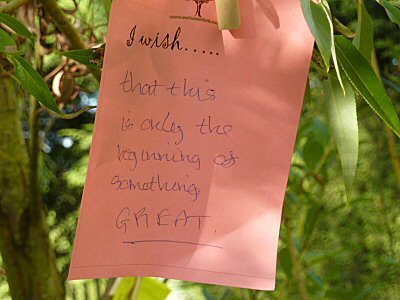
Where the wishes grow on trees

Like this one, which has a certain appeal for us...

And a lot of information ended up in the programme - so it's uploaded here for you can see more of what went on...

More later. Goodnight - and thank you all!